Category
New to Kosher Wine
Kosher wine basics in plain English: mevushal, reading a label, choosing a glass, and tasting with confidence.
Let me save you some time. Nobody waves a wand over kosher wine. There's no secret blessing, no rabbi in the vineyard humming over the grapes. I checked.
If "kosher wine" still means that thick purple syrup from your childhood Seder, the one that tasted like grape jelly with ambition, welcome. You're exactly who I wrote this for. I'm Anne Gershkowitz. I passed WSET Level 3, the advanced exam wine professionals take, with Merit, and I'm now studying for the WSET Diploma, its highest qualification. I also drink only kosher wine. Let's cover what actually makes a wine kosher, what mevushal means, how to read the label, which myths to retire, and five bottles to buy first.
Quick answer
Kosher wine is grape wine made under Jewish law, handled by Sabbath-observant Jews from crush to bottle. Look for a hechsher (a kosher symbol) on the label. Mevushal means it was flash-heated so anyone can pour it. And kosher does not mean sweet.
What makes wine kosher?
It's who handles the wine, not a blessing
From the moment the grapes are crushed, only Sabbath-observant Jews may handle the wine and the winery equipment. A mashgiach (kosher supervisor) keeps watch. Everything that touches the wine has to be kosher too, from the yeast to the fining agents winemakers use to clear it. Some common ones, like gelatin, are not.
Israeli wineries follow extra farming laws from the Torah. Fruit from a vine's first three years is off-limits (orlah), every seventh year has its own rules (shmita), and a small portion is set aside as a tithe. None of this changes how good the wine can be. It changes who is in the cellar.
The grapes are fine. The process is the point.
A grape is kosher straight off the vine, and it's pareve (neither meat nor dairy). Wine is different because it plays a holy role. We bless it every Friday night, and in ancient times other nations poured it as an offering to idols. So the rabbis drew a careful line around who makes and handles kosher wine. That's the whole reason for the supervision. I pour, the rabbis rule, and for the fine print I'll always send you to yours.
Kosher isn't automatically kosher for Passover
Grape wine has no grain in it, so most kosher wines are also kosher for Passover. Most, not all. It depends on details like the yeast and the equipment, so look for "Kosher for Passover" on the label or a P next to the symbol, like OU-P. And no, that P does not mean pareve. Getting ready for the Seder? My Passover page is where those guides live.
What does mevushal mean?
Mevushal is Hebrew for "cooked." Today it means the wine was flash-heated for a few seconds, then cooled right away. Nobody is simmering your Merlot on the stove.
Why mevushal wine exists
Under traditional kosher law, a regular (non-mevushal) kosher wine stays kosher only while Sabbath-observant Jews open and pour it. Mevushal wine stays kosher no matter who pours. That's why caterers, restaurants and wedding halls love it. Your waiter doesn't have to be your rabbi.
Is mevushal wine worse?
Old-school boiling really did flatten wine, and that's where the bad reputation comes from. Modern flash heating is quick and far gentler. Done well, it's often hard to tell. A delicate older red may lose a little sparkle, while a fresh white or rosé usually shows no difference at all. Judge the wine in your glass, not the word on the back label.
How to tell if a wine is mevushal
Check the back label near the kosher symbol for the word "mevushal" (sometimes in Hebrew, מבושל). If it doesn't say so, assume it isn't. It matters most when you're hosting with a caterer or bringing a bottle to someone else's table.
How do you read a kosher wine label?
Find the hechsher
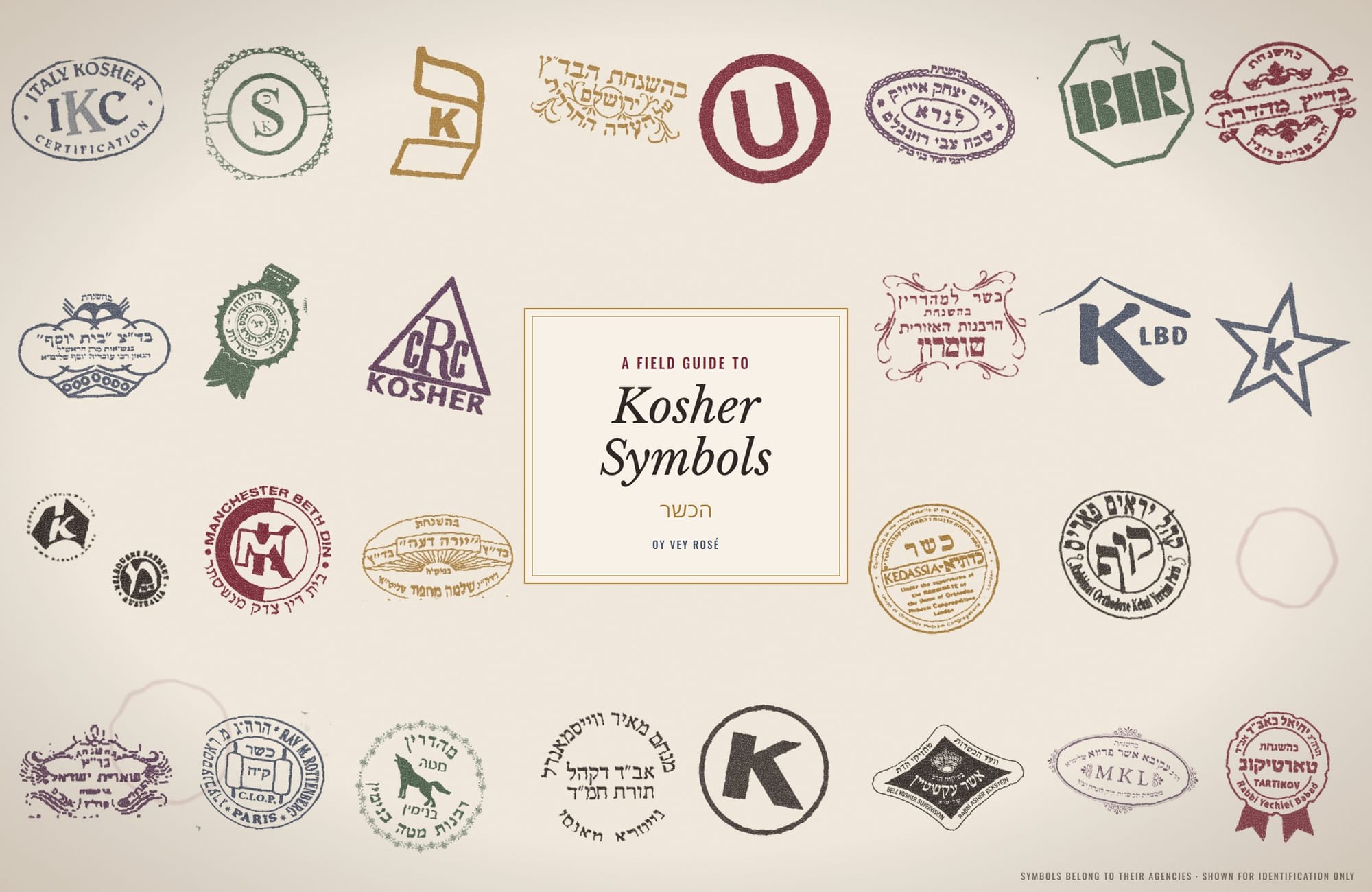
A hechsher is the little symbol that tells you who supervised the wine. There are dozens of them, from big American agencies to Hasidic courts and Israeli rabbinates. Here are the ones you're likely to spot on a wine shelf. In my posts, I always tell you exactly what's on the bottle.
Who's behind each symbol
United States
- OUOrthodox Union, New YorkOn my table: L'Indiscrète, Covenant, Shirah
- OKOK Kosher Certification, Brooklyn
- Star-KStar-K Kosher Certification, Baltimore
- Kof-KKof-K Kosher Supervision, Teaneck, NJ
- cRcChicago Rabbinical Council
- HisachdusBeth Din Hameyuchud L'inyonei Kashrus of the Central Rabbinical Congress, Brooklyn
- TartikovRabbi Yechiel Babad, the Tartikover Rav, Brooklyn
- BelzVaad Hakashrus Belz USA, Brooklyn
- WeissmandlRabbi Menachem Meir Weissmandl, Rav of Nitra, Monsey
United Kingdom
- KLBDLondon Beth Din
- KedassiaUnion of Orthodox Hebrew Congregations, London
- MKLRabbi Akiva Osher Padwa, London
- BIRBadatz Iggud Rabbonim, Manchester
- MBDManchester Beth Din
France
- Kehal YereimRabbinate Kehal Yereim, Paris
- C.I.O.P.Rabbi Rottenberg, Paris
Israel
- BadatzBadatz Eidah HaChareidisJerusalem
- BadatzBadatz MehadrinRechovot
- LandauRabbi Landau, Bnei Brak
- SeckbachRabbi Moshe Seckbach, Modiin Illit
- Yoreh DeahBadatz Yoreh DeahRabbi Shlomo Machpud
- BadatzBadatz Sheirit YisraelBnei Brak
- BinyaminMehadrin Mateh BinyaminRegional rabbinate, Mateh Binyamin
- ShomronMehadrin ShomronRegional rabbinate of the Shomron
- BadatzBadatz Beit YosefSephardic certification founded under Rabbi Ovadia Yosef, IsraelOn my table: Lueria
- RabbanutChief Rabbinate of Israel, through local rabbinates
Elsewhere
- KAKosher Australia, Melbourne
- IKCItaly Kosher Certification, Rome
This is a who's who, not a ranking. Spotted a symbol that isn't here? The Chicago Rabbinical Council keeps a long list of kosher agencies it accepts, and it notes that wine is one of the areas that needs extra care even with a familiar symbol. Which symbols you rely on is between you and your rabbi.
Look for Passover, mevushal and sweetness clues
Once you've found the symbol, look around it for "Kosher for Passover" and "mevushal." Then figure out the style. Kosher says nothing about sweetness. The grape name (Sauvignon Blanc, Cabernet, Syrah) or the word "dry" usually means dry, and "brut" means a dry sparkling wine. "Concord," "semi-sweet" or "Kiddush wine" signal sweet. That's not a crime. Just know what you're buying.
Screwcap or cork?
A screwcap is not a cheap shortcut. It keeps fresh whites crisp and protects against cork taint (that musty, wet-cardboard smell). Plenty of excellent wineries use them. Kosher-wise, the cap makes no difference at all.
Kosher wine myths, busted
| Myth | The truth |
|---|---|
| Kosher wine is always sweet | There's a huge world of dry kosher wine from Israel, France, Spain and California. Sweet is one style, not the rule. |
| A rabbi blesses it | Kosher comes from supervision and process. No blessing, no wand. |
| Mevushal means ruined | Modern flash heating is gentle. Done well, it's often hard to tell. |
| Israeli wine is automatically kosher | Many Israeli wineries, especially small ones, aren't certified. Look for the hechsher. |
| Pricier means more kosher | A $15 bottle and a $150 bottle with the same hechsher are equally kosher. Price buys craft, not kashrut. |
| You need separate wine for meat and dairy | Wine is pareve. The same bottle works at a dairy brunch or a brisket dinner. Pair for flavor. |
| Only Jews care about kosher wine | Hosts with kosher guests, event planners and curious wine lovers all buy it. A kosher bottle lets everyone at the table share it. |
Why did American kosher wine go sweet in the first place? Concord grapes grew well in New York, and they make a tart, grapey wine, so producers added sugar. Generations of Seders followed. So if your Bubbe's sweet Concord still tastes like every Seder you ever loved, pour it with pride. Memory is a flavor too.
Your first five kosher wines
Here's where I'd start, one style at a time. Every bottle below is one I've poured with a recipe on this site, so you can see exactly what it does at the table.
1. A bone-dry Sauvignon Blanc
Crisp, citrusy and as refreshing as cold water on a hot day. My pick is Anthony Girard's L'Indiscrète Sancerre 2023 from the Loire Valley in France. Its high acidity (that mouth-watering zing) slices through olive oil and tahini, which is why I poured it with my five 20-minute challah dips.
- Kosher OU
- Mevushal No
- Passover Kosher for Passover
2. A dry Alsace Riesling
If you think Riesling means sweet, Alsace would like a word. Cave du Bollenberg Riesling is dry, zesty and full of lime and white peach. It's also mevushal, which makes it my go-to for parties and catered events. It's the bottle that cooled down my swicy tamarind za'atar wings.
- Mevushal Yes
- Passover Kosher for Passover
3. A Chardonnay without the butter bomb
Forget the heavy, oaky Chardonnays you may remember. Lueria's Unoaked Chardonnay from Israel's Upper Galilee is bone dry and bright, perfect with my one-pan pepper chicken. Want just a touch of oak? Covenant Lavan Chardonnay from California brings white peach and lemon, and it's what I pour with my kosher chicken Kyiv.
- Lueria Badatz Beit Yosef
- Covenant Lavan OU
- Mevushal No (both)
- Passover Kosher for Passover (both)
4. A peppery Syrah
Ready for red? Syrah brings dark fruit, black pepper and firm tannins (that drying grip on your gums), so it loves rich, spiced food. Shirah's "Power to the People" Syrah 2020 from California's Central Coast stood up to my Tashkent meat samsa. For dark plum and a hint of cocoa, Galil Mountain Yiron Syrah from Israel was made for my pomegranate meatballs.
- Shirah OU
- Mevushal No (both)
- Passover Kosher for Passover (both)
5. A Kiddush wine you actually enjoy
Friday night Kiddush deserves a wine you look forward to. If that's a sweet one, wonderful. Sweet is a style, not a sin. If you're curious, try one of the dry bottles above for Kiddush and keep it on the table through dinner.
How to shop without spiraling
- Pick the meal first. Chicken, fish or dips? Go white. Brisket, lamb or anything spiced? Go red.
- Shop by grape, not label art. Pretty labels have fooled better people than us.
- Check three things on the back: the hechsher, mevushal (if a caterer or guest will pour) and Passover (in spring).
- Ask the shop for help. "What's dry and fresh?" is a perfectly smart question.
- Snap a photo of every label you love. Your phone is now your wine cellar's memory.
How do you taste wine with confidence?
My WSET training boils down to three steps anyone can do at the table. No spitting required (unless you're me, at a tasting, at 10 a.m.).
- Look. Tilt the glass over a white napkin. Whites turn golden as they age, and reds fade from purple toward brick.
- Smell. Swirl, then sniff. Name just one thing you smell: lemon, cherry, pepper, flowers. My grandkids were my first "aroma apprentices," sniffing everything from rosemary to blackberries. If they can do it, so can you.
- Sip. Is it dry or sweet? Does it make your mouth water? That's acidity. Does it grip your gums? That's tannin. How long does the flavor stay after you swallow? Longer usually means better.
Then the pairing rule I use most: match weight with weight, and let acidity cut the fat. Light dishes want light wines, rich dishes want fuller ones. You'll find it in action every week on my Shabbat food and wine pairing page.
And the glass? When I started my WSET studies, I convinced myself I needed Riedel's Bordeaux and Pinot Noir glasses. My husband nearly fainted at the price, then asked for a set of his own. I poured the same wine into an everyday glass and into the Riedel, and the difference was real: clearer, livelier aromas. You don't need fancy crystal, though. A thin glass with a bowl that narrows at the top, filled only a third of the way, gets you most of the way there.
Where to go next
- Shabbat Food & Wine Pairing: what to pour on Friday night.
- Jewish Holidays: guides for Rosh Hashanah, Sukkot, Hanukkah and Passover.
- The True Heart of Sukkot: why wine matters at the table, beyond the pairing.
- About me: who's pouring, and why kosher wine is personal for me.
Kosher wine FAQ
Is all Israeli wine kosher?
No. Many Israeli wineries, especially small boutique ones, aren't certified. Always look for a hechsher on the label.
Can non-Jews drink kosher wine?
Absolutely. Kosher wine is simply wine made under supervision. Anyone can enjoy it, and it's the easiest way to make sure kosher-keeping guests can share the bottle.
Does mevushal matter at home?
It matters most when someone who isn't Sabbath-observant will open or pour the wine, like a caterer, waiter or guest. If that's a question in your home, ask your rabbi.
What's a good first kosher wine?
Start with a crisp, dry white like a Sauvignon Blanc or an unoaked Chardonnay. They're easy to like and go with almost any Shabbat meal.
Is Manischewitz kosher?
Yes. Manischewitz's classic wine is a sweet Concord grape wine, and it carries kosher certification. As with any bottle, check the label for the hechsher and for Passover status.
What does "kosher for Passover" mean on wine?
It means the wine was also made to the stricter Passover standard, with no contact with chametz (leavened grain). Look for the words on the label or a P next to the kosher symbol.
I'm a wine educator, not a rabbi. For kashrut questions, follow your own rabbi and the hashgacha (kosher supervision) you trust.
Now you know more about kosher wine than most people at the table. Subscribe for a new pairing every week, and come say hi on Instagram and TikTok at @oyveyrose. Pour something good, and stay a while. L'Chaim!
The first posts are on their way.
Subscribe and they'll come straight to your inbox.